How Distributed Application Runtime (Dapr) has grown since its announcement
Since the October 2019 announcement of the Distributed Application Runtime (Dapr), we have seen a tremendous response and the emergence of an engaged Dapr community.


Traditional security processes can often become a roadblock when delivering software via DevOps processes at the rate that today’s business world demands. Today, security is not just the responsibility of the security teams—it is a shared responsibility among all the teams in the applications lifecycle. This integration is known as DevSecOps.
Modern application infrastructure is being transformed by containers. The question is: How do you get started? Understanding what problems containers, Docker, and Kubernetes solve is essential if you want to build modern cloud-native apps or if you want to modernize your existing legacy applications.
With the release of Terraform 0.12, we can improve the configuration of our infrastructure resources that are using the Azure Terraform Resource Provider. In this post, we will discuss how we can use Terraform 0.12 to organize, configure, and deploy resources to Azure. What is Terraform 0.
Today, we rely on our everyday services to be delivered digitally and expect the experience to be instant. In order for customer-facing applications to respond to users in 100ms, you need a high-performance database capable of handling a variety of application scenarios at the lowest complexity and cost, with uncompromising performance.
In our last post, Daniel Semedo and I provided an overview of how to add automated performance quality gates using a performance specification file, as defined in the open source project Keptn Pitometer. In this post, I’ll explain the steps required to add a performance quality gate to your Azure DevOps pipelines for both DevOps “Multi-Stage” and “Classic” pipelines using Keptn Pitometer.
I’m a developer and I’ll admit it, I’m learning Kubernetes. I’ve been developing web applications now for more than 20 years; however, the past two years I’ve moved to working with microservices applications. Originally the microservices were web sites on multiple virtual machines.
This blog dives into monitoring-as-code ad adding automated performance quality gates into your software delivery pipelines. We’ll walk through examples using a web microservice app and an Azure function app that we developed as open source services that help you qualify the overall performance and quality of applications.
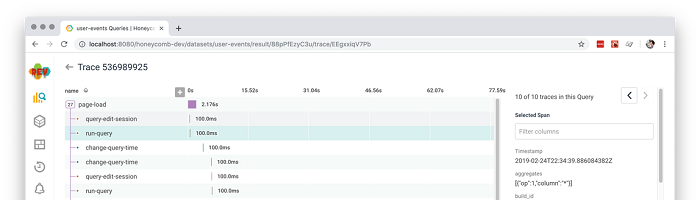
Honeycomb is a tool for introspecting and interrogating your production systems. It’s a new type of tool, designed to infuse observability across platforms, microservices, serverless apps, and increasingly complex systems, as well as all the way down to individual customers.
What is a secret In this blog, we will show you how HashiCorp Vault can help you manage and eliminate secrets sprawl in Azure and your broader organization in general. Before we dive into defining what secret sprawl is, however, it’s good to understand what we define as a secret.
Prior to March 2019 we, the JUnit team, used various continuous integration (CI) services to perform CI checks, from a self-managed Jenkins instance on CloudBees to a Travis CI and AppVeyor setup.
In recent years, many developers have discovered the power of distributed tracing for debugging regressions and performance issues in their backend systems, especially for those of us with complex microservices architectures.