

Last year Microsoft acquired Revolution Analytics, the leading commercial provider of software and services for R, an open source, statistical programming language that’s widely used for statistical computing and predictive analytics. Since then, there has been a steady cadence of updates to Revolution R Open and Revolution R Enterprise, as well as the integration of R with Microsoft Azure, SQL Server, PowerBI, and Cortana Analytics.
This month, Microsoft’s Machine Learning team announced a long list of updates to bring R-based analytics to new platforms, developers and the R community, including:
- Revolution R Enterprise for Hadoop, Linux and Teradata is now available as Microsoft R Server with all the benefits of Microsoft’s enterprise-grade quality, support and purchasing options.
- A new Microsoft R Server Developer Edition with all the features of the commercial version will be available as a free download.
- The Microsoft Data Science Virtual Machine will include a pre-installed and pre-configured version of Microsoft R Server Developer Edition.
- Revolution R Open is now Microsoft R Open and is available as a free download.
- Microsoft R Server is available to all students for academic use with the Microsoft DreamSpark program.
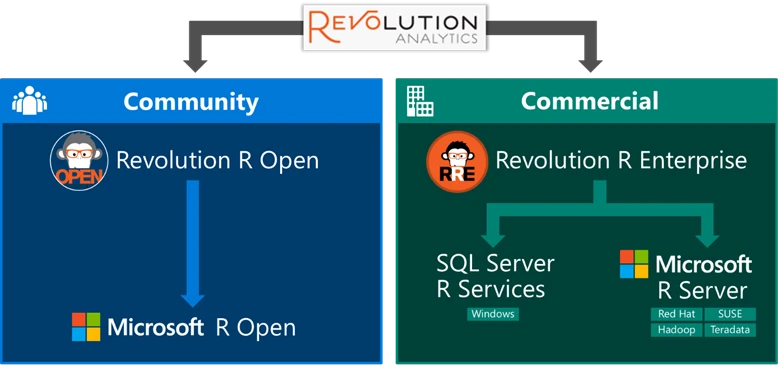
“Delivering Microsoft R Server across multiple platforms allows our enterprise customers to standardize advanced analytics on one core tool, regardless of whether they are using Hadoop (Hortonworks, Cloudera and MapR), Linux (Red Hat and SUSE) or Teradata,” wrote Joseph Sirosh, Corporate Vice President, Microsoft Data Group. “For Windows, Microsoft R Server will be included in SQL Server 2016 as SQL Server R Services – and the combined bundle is less expensive than RRE standalone. Until SQL Server 2016 is released, Revolution R Enterprise for Windows remains available as a standalone product.”
For more on these updates and how to get started with R, check out the Machine Learning blog.